Blog
- Home
- ASP.NET Core
- My "Introducing ASP.NET Core 2.0" lesson's review
My "Introducing ASP.NET Core 2.0" lesson's review
1) .NET Standard
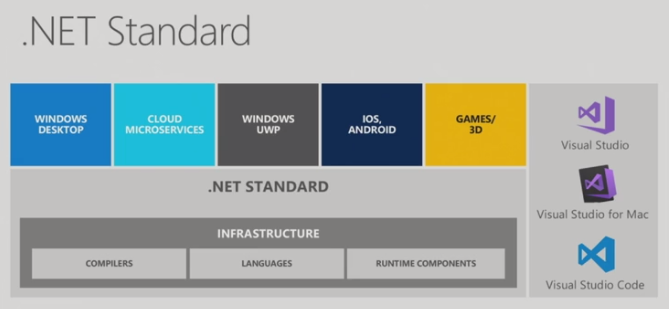
- .NET Standard isn't a framework but an agreement, an interface. .NET Standard is a series of APIs that the multiple implementations of .NET agree on
- .NET Standard provides a specification for any platform to implement. It allows sharing code, binaries, and skills between .NET client, server and all flavors.
- All .NET runtimes provided by Microsoft implement the standard
How to test
You have to install the .NET Core 2.0 framework and the preview of Visual Studio 2017. Visual Studio 2017 Preview will install a separate instance of Visual Studio 2017, so you can have Visual Studio 2017 and Visual Studio 2017 Preview side by side.
Application configuration
- The ASP.NET Core team rolled back the project.json file, to come back to an old-style CSPROJ, still in XML but with a much lighter format
- The package dependency management allows you to reference packages of packages, to avoid referencing dozens of packages manually, but you can still do that if you prefer
- The host and application configuration is now managed by the Dependency Injection module, which simplifies the process and adds more flexibility
- The default configuration file format is still JSON
Razor Pages
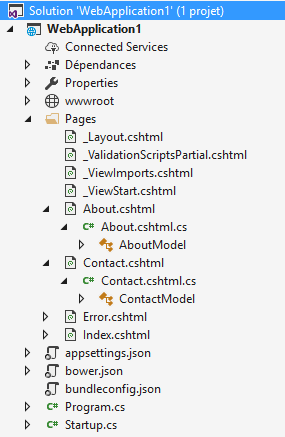
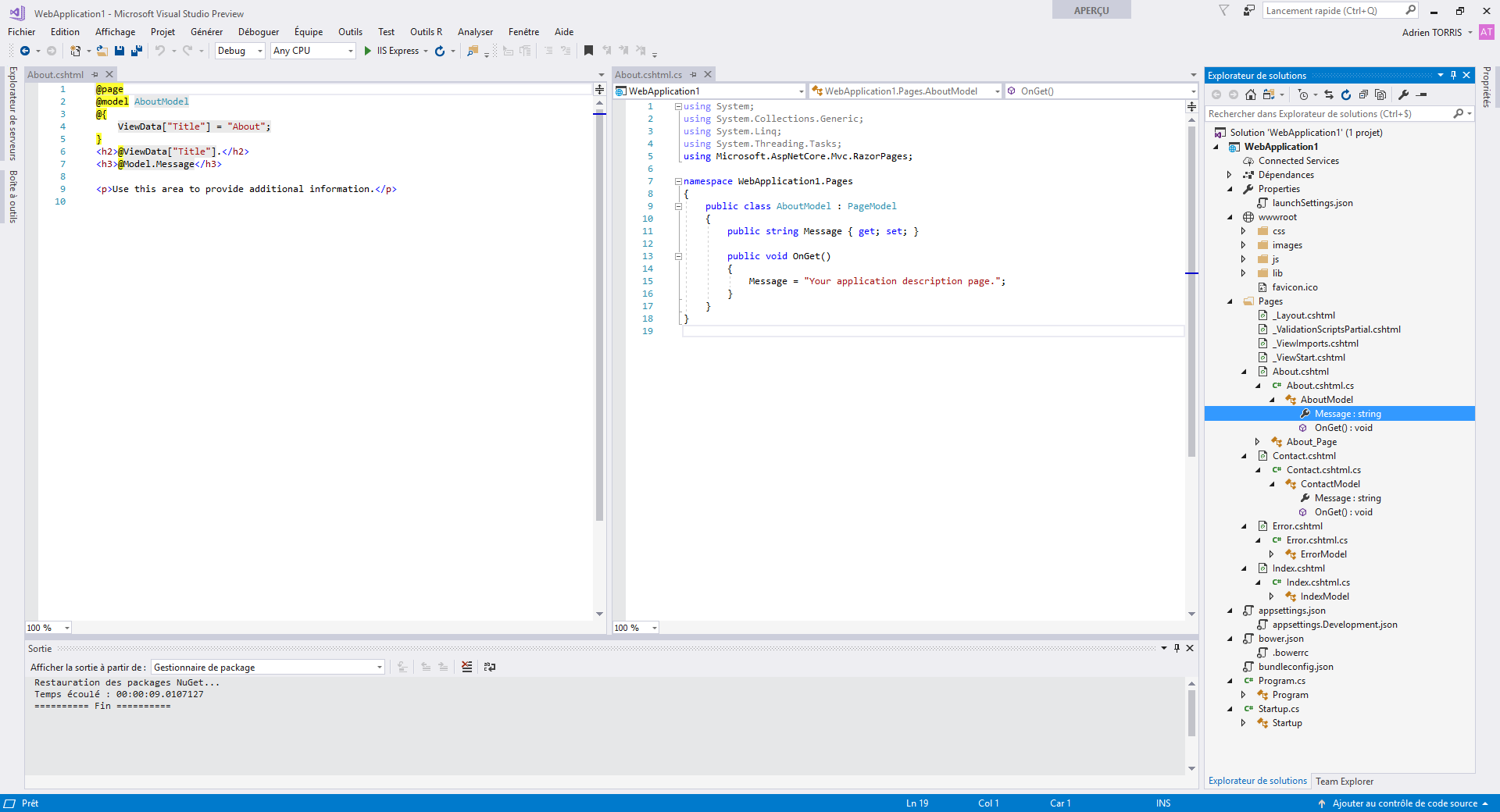
- Razor Pages are pages, not views
- The "Pages" folder is interpreted and disappears from the page URLs (/Pages/awesome.cshtml -> /awesome)
- Razor Pages are not the future of MVC, they are another option within MVC
Razor Pages Sample by Damian Edwards on GitHub
SignalR
- Will be introduced in a future version of ASP.NET Core

Performance
- ASP.NET Core 2.0.0 is 25% faster than ASP.NET Core 1.1
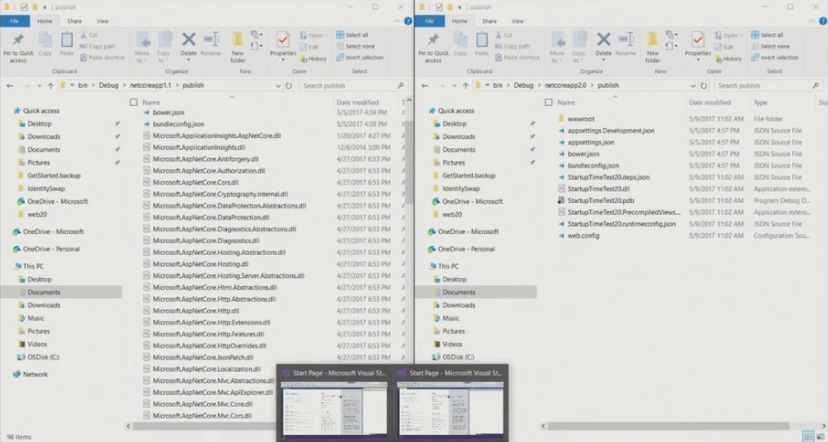
- The published files are much lighter than with ASP.NET Core 1.1
Azure
- Application Insights
- Azure AD B2C
Notes
- Kestrel is the name of the tiny cross-platform web server
- There is a certificate store in Visual Studio
Remarks
- The demo starts with Visual Studio Code, the .NET Core CLI and Google Chrome, an "impartial browser" ( :) ), and then switches to Visual Studio 2017 Preview. Interesting to see that a lot of demos from Build 2017 use Visual Studio Code instead of Visual Studio, and Git instead of TFVC when source control software is needed. Google Chrome makes a lot of appearances too.
- Channel 9 is a really great source of knowledge
- Scott Hanselman is awesome
May 30, 2017